
Exporting Industry and Machinery: markets, headings and fairs
The Industry and Machinery sector spans 21 tariff chapters covering metals, machinery, vehicles and equipment. Spain exported EUR 171.5 billion to the…
Published on 14 September 2026Updated on 28 September 2026
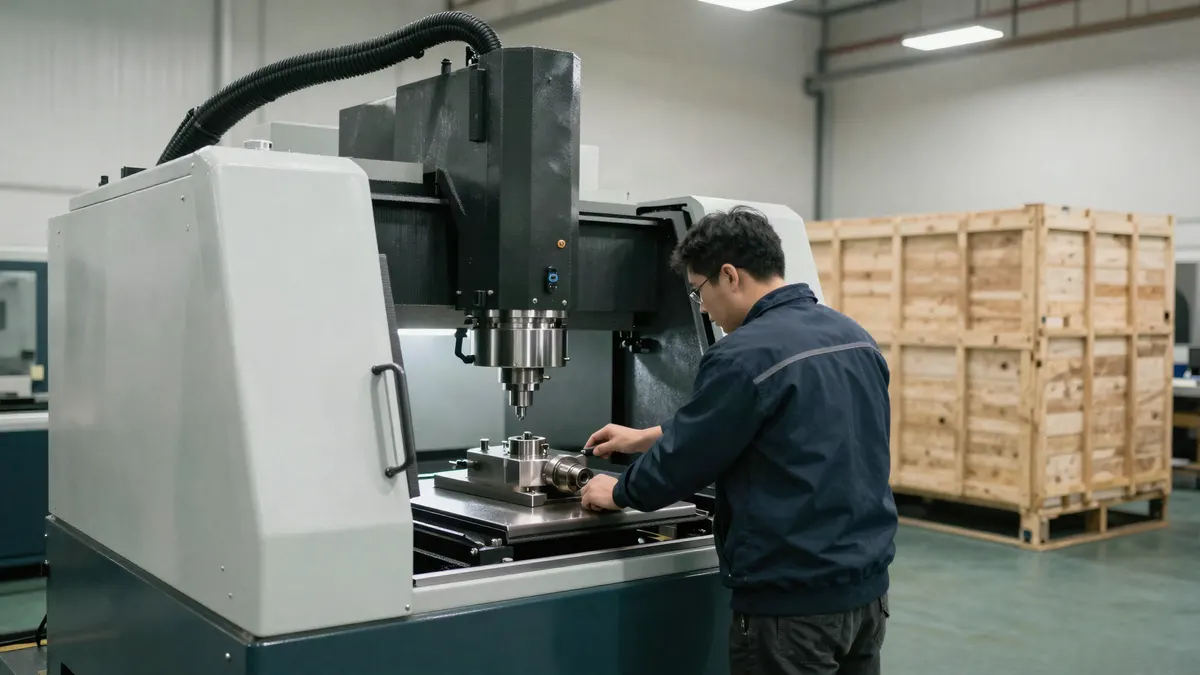
The Industry and Machinery sector spans 21 tariff chapters covering metals, machinery, vehicles and equipment. Spain exported EUR 171.5 billion to the world in 2025, competing in a market led by the United States, Germany and France. Understanding tariff codes, origin rules and destination regulations is essential to ship competitively.
Tariff chapters in this sector
- Plastics and articles thereofChapter 39
- Rubber and articles thereofChapter 40
- Pulp of wood or other fibrous cellulosic material; recovered (waste and scrap) paper or paperboardChapter 47
- Paper and paperboard; articles of paper pulp, of paper or paperboardChapter 48
- Printed books, newspapers, pictures and other products of the printing industry; manuscripts, typescripts and plansChapter 49
- Iron and steelChapter 72
- Iron or steel articlesChapter 73
- Copper and articles thereofChapter 74
- Nickel and articles thereofChapter 75
- Aluminium and articles thereofChapter 76
- Lead and articles thereofChapter 78
- Zinc and articles thereofChapter 79
- Tin; articles thereofChapter 80
- Metals; n.e.c., cermets and articles thereofChapter 81
- Tools, implements, cutlery, spoons and forks, of base metal; parts thereof, of base metalChapter 82
- Metal; miscellaneous products of base metalChapter 83
- Machinery and mechanical appliances, boilers, nuclear reactors; parts thereofChapter 84
- Railway, tramway locomotives, rolling-stock and parts thereof; railway or tramway track fixtures and fittings and parts thereof; mechanical (including electro-mechanical) traffic signalling equipment of all kindsChapter 86
- Vehicles; other than railway or tramway rolling stock, and parts and accessories thereofChapter 87
- Aircraft, spacecraft, and parts thereofChapter 88
- Ships, boats and floating structuresChapter 89
- Arms and ammunition; parts and accessories thereofChapter 93
Main importing markets
USD · 2025| Country | Imports (USD) |
|---|---|
| United States | 1,347,242,894,429 |
| Germany | 584,257,874,010 |
| China | 566,126,442,471 |
| France | 310,588,598,766 |
| Mexico | 307,295,612,576 |
| United Kingdom | 299,239,016,131 |
| Canada | 259,123,475,445 |
| Italy | 234,988,491,317 |
| Netherlands | 194,565,327,208 |
| Poland | 182,495,836,857 |
| India | 181,658,326,667 |
| Japan | 177,760,640,853 |
| Spain | 171,490,029,184 |
| South Korea | 167,020,872,290 |
| Türkiye | 156,155,657,843 |
Imports declared by each country from the world. Countries report with a delay: the period is the latest with consolidated data.
Source: UN ComtradeData for 2025Verified on 28 September 2026
What you need to know to export machinery and industrial goods
The Industry and Machinery sector is fragmented across 21 HS chapters. Each tariff code carries its own import duties, rules of origin, and compliance requirements. Misclassifying a product by even one digit can increase your freight costs by 5–15 percentage points at destination.
Origin marking is mandatory for machinery and metal goods in most markets. The EU preferential origin rules apply when you export from Spain to third countries with which the EU has a trade agreement—typically if the product contains at least 45% EU added value. Without proof of origin, your buyer may pay the full non-preferential tariff, which typically ranges from 5% to 15% for machinery.
CE marking and technical compliance are required for machinery shipped to the EU or markets that adopt EU standards. Non-EU destinations often have their own standards: Mexico, Canada and India use distinct certification schemes. Verify the standard for each tariff code and destination before production.
Lead times for customs clearance and testing vary sharply by destination and product. The EU typically clears machinery within 24–48 hours; Mexico and India may require 5–10 working days. Plan your shipment schedule accordingly, especially for perishable components or time-sensitive orders.
Questions about exporting machinery and industrial goods
How do I know which tariff chapter applies to my product?
The tariff chapter depends on the product's composition, function and intended use. For machinery, Chapter 84 covers most appliances; for metals, Chapters 72–80 cover primary materials, and Chapters 74–83 cover fabricated articles. Use the HS nomenclature rules to classify by material first, then by function. If unsure, ask your freight forwarder or customs broker to confirm the code before your first shipment; an error can trigger fines and delays.
Do I need a different certificate for each destination?
No single certificate covers all destinations. CE marking is mandatory for the EU and most countries that adopt EU standards. The US, Mexico and Canada accept USMCA or national certifications; India requires Bureau of Indian Standards (BIS) approval for certain products. Check the destination's technical regulations early in your product development. A certificate valid in one market may not be valid in another.
What happens if my product is classified under the wrong tariff code?
Your buyer is charged a higher tariff rate, which reduces the competitiveness of your quote. In some cases, customs authorities may hold the shipment until classification is resolved. To avoid this, classify your product using the official HS nomenclature and confirm the code with your customs broker before shipping. Include the agreed code on your commercial and shipping documents.
Are there tariff-free opportunities for machinery exports from Spain?
Machinery exported under the EU preferential origin rules to countries with which the EU has a trade agreement (most of the world outside the US, China and Russia) face reduced or zero duties if they meet the 45% EU added-value threshold. Machinery shipped to the US under USMCA faces 0–5% duties if it meets USMCA origin rules. Check whether your buyer qualifies under the relevant agreement before quoting.
Bring this analysis to your product
Create your free account: Exporta.ai reads your website, detects your HS code and tells you which markets to export to, with official data.