
Exporting Food and Drink: markets, headings and fairs
Food and drink is one of Spain's strongest export sectors. The US, Germany, and the UK are the largest importers globally, each buying over USD 50…
Published on 15 September 2026Updated on 28 September 2026
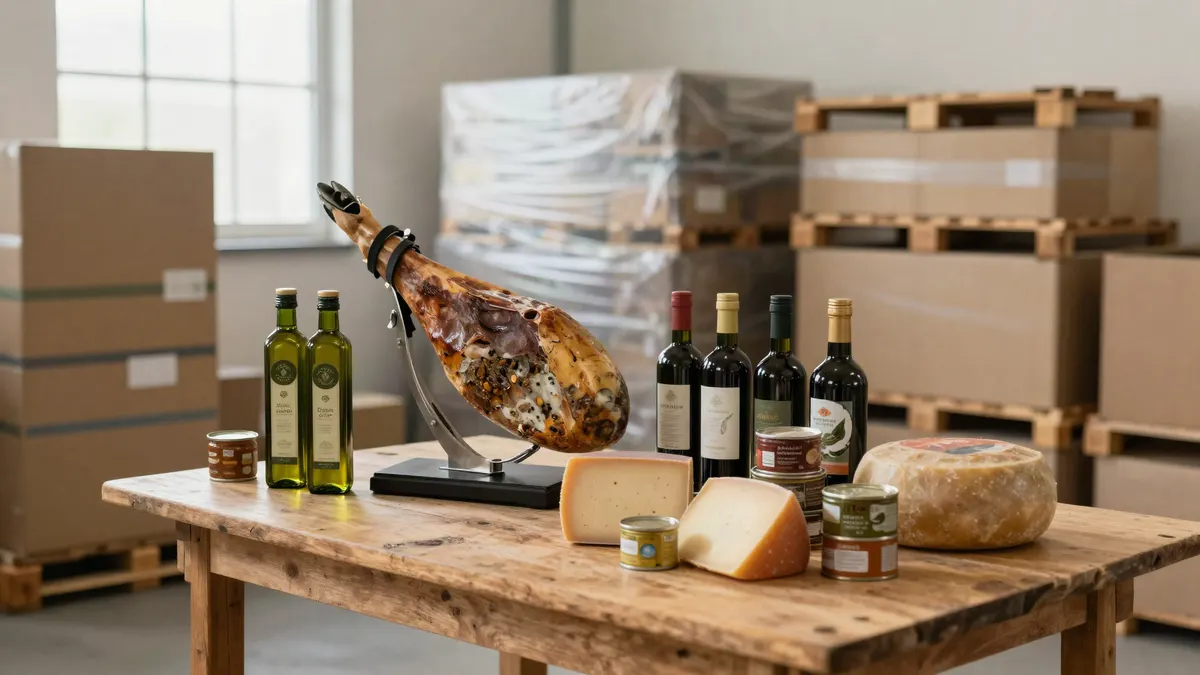
Food and drink is one of Spain's strongest export sectors. The US, Germany, and the UK are the largest importers globally, each buying over USD 50 billion annually. Spain itself is a major importer, suggesting competitive local production and re-export potential. Export success depends on understanding tariff codes, compliance requirements, and which markets value your product.
Tariff chapters in this sector
- Meat and edible meat offalChapter 02
- Fish and crustaceans, molluscs and other aquatic invertebratesChapter 03
- Dairy produce; birds' eggs; natural honey; edible products of animal origin, not elsewhere specified or includedChapter 04
- Products of the milling industry; malt, starches, inulin, wheat glutenChapter 11
- Animal, vegetable or microbial fats and oils and their cleavage products; prepared edible fats; animal or vegetable waxesChapter 15
- Meat, fish, crustaceans, molluscs or other aquatic invertebrates, or insects; preparations thereofChapter 16
- Sugars and sugar confectioneryChapter 17
- Cocoa and cocoa preparationsChapter 18
- Preparations of cereals, flour, starch or milk; pastrycooks' productsChapter 19
- Preparations of vegetables, fruit, nuts or other parts of plantsChapter 20
- Miscellaneous edible preparationsChapter 21
- Beverages, spirits and vinegarChapter 22
- Tobacco and manufactured tobacco substitutes; products, whether or not containing nicotine, intended for inhalation without combustion; other nicotine containing products intended for the intake of nicotine into the human bodyChapter 24
Main importing markets
USD · 2025| Country | Imports (USD) |
|---|---|
| United States | 165,302,411,454 |
| Germany | 97,218,143,415 |
| China | 92,653,669,338 |
| United Kingdom | 70,054,149,443 |
| France | 67,135,658,720 |
| Netherlands | 65,738,644,266 |
| Italy | 52,479,246,649 |
| Japan | 50,735,168,246 |
| Spain | 41,802,481,312 |
| Canada | 36,270,906,831 |
| Belgium | 34,201,922,834 |
| South Korea | 27,691,317,452 |
| Poland | 27,033,838,529 |
| Mexico | 26,587,752,847 |
| India | 24,108,458,399 |
Imports declared by each country from the world. Countries report with a delay: the period is the latest with consolidated data.
Source: UN ComtradeData for 2025Verified on 28 September 2026
Trade fairs in this sector
- Alimentaria BarcelonaBarcelona
- AnugaCologne
- BIOFACH – World’s Leading Trade Fair for Organic FoodNúremberg
- Fruit AttractionMadrid
- GulfoodDubái
- ProWein DüsseldorfDüsseldorf
- Salón GourmetsMadrid
- SIAL – Salon International de l’Alimentation (SIAL Paris)París
- Summer Fancy Food ShowNueva York
- Wine Paris & Vinexpo ParisParís
What you need to know before exporting food and drink
Food and drink exports face stricter compliance than most sectors. Every product falls under one of 13 tariff chapters—from fresh meat (Chapter 02) to beverages (Chapter 22)—and each chapter has its own rules on labelling, traceability, hygiene, and certification. Your first step is to identify your product's exact tariff code, because the code determines your applicable tariffs, your compliance obligations, and which markets give you preferential access.
Labelling and certification requirements vary by destination. The US requires English labels with specific allergen warnings; the UK applies similar rules post-Brexit; some Asian markets require specific origin certificates or phytosanitary clearance. Most require proof of food safety compliance, often under HACCP or equivalent standards. Before you quote a price, confirm your buyer's exact requirements with the importer or consult a trade body in your sector.
Your production facility must meet the importing country's food safety standards. The EU's FSSC 22000 or BRC certification is often accepted internationally, but not always. Some markets—Japan, South Korea, some US states—require their own inspection or approval. Check with your buyer and with your sector association or chamber of commerce before committing to a new market.
Transportation costs and lead times matter more in food than in most sectors because products spoil or age. Export to nearby markets (UK, France, Portugal, Italy, Germany) first; they offer shorter lead times, lower transport costs, and easier returns if compliance issues arise. Distant markets (US, Japan, Australia) require longer shelf life, cold chain logistics, and higher working capital—and higher margins to compensate.
Price competitiveness in food is global. The US and Germany together import over USD 260 billion annually in food and drink; Spain competes with Italy, France, Poland, and India for those buyers. Your margin depends on your product's uniqueness (origin, certification, recipe) and your buyer's willingness to pay for it. Generic products face thin margins; certified, traceable, or regionally-protected products command premiums.
Common questions about exporting food and drink
How do I know which tariff chapter my product belongs to?
Start with your product's main ingredient or purpose. Meat products go in Chapter 02, fish in Chapter 03, processed foods in Chapters 16–21 depending on the main component. Once you have a candidate chapter, use the online TARIC tool (for EU exports) or Access2Markets to find the exact 8-digit code. The code tells you the applicable tariff, quota, and any special rules. If you're unsure, ask your sector association or a customs broker.
Do I need different certificates for different markets?
Most markets require a health certificate (phytosanitary for plant-based products, veterinary for animal products) and proof of food safety compliance. Within the EU, you need an EU health mark. Outside the EU, each country has its own rules. The US, UK, Japan, and China often require importer pre-notification or facility approval. Ask your buyer which certificates they need before you export; don't assume one certificate works everywhere.
What's the typical export process for a food shipment?
Order logistics: buyer places order and confirms requirements; you prepare product and arrange certification; product is packed and labelled to spec; you arrange transport (often refrigerated) and get export health certificate from your country's authority; shipment leaves with all documentation; buyer's customs clears it on arrival; product is delivered. Timeline is typically 2–4 weeks for EU destinations, 4–8 weeks for transatlantic or Asia-Pacific. Cold chain breaks cost time and money, so plan transport carefully.
Are there tariffs on Spanish food exports to other EU countries?
No tariffs exist between EU member states for products that meet EU standards. Your product only faces tariffs when it leaves the EU. The UK, after Brexit, now applies tariffs to many food products from Spain; check the specific tariff for your product using Access2Markets.
How do I find buyers for my product?
Use sector-specific trade platforms (such as regional chambers of commerce or sector associations) to find distributors, importers, or retailers in your target market. Attend sector fairs in major importing countries (US, Germany, UK, Japan) to meet buyers in person. Start with countries where Spain already has a strong presence in your category; they have established supply chains and fewer compliance surprises.
Bring this analysis to your product
Create your free account: Exporta.ai reads your website, detects your HS code and tells you which markets to export to, with official data.